Showing posts with label japanese travel. Show all posts

Saturday, November 7, 2009

THE POTTERIES OF SETO

I happened to find the following article quite by accident while doing research for several projects for our publishing company, Shisei-Dō Publications, here in Japan. The following article by Basil Hall Chamberlain[i] was part of his A Handbook for Travelers In Japan, (Also known as the Handbook to the Japanese Empire) first published in 1891 (this is from the 1894 revised editon) as part of the then extremely popular and famous travel guides published by John Murray[ii].
This brief article relates to the famous pottery region of central Honshū, which includes Mono, Tajimi, Ichinokura, and surrounding area, our home. Several references are made to places we noted in previous essays on this blog and we invite you to read them as well. For us it was fun to read about our area as recorded in the middle of the Meiji Era. We hope you will find this essay by Chamberalin both informative and entertaining.


ROUTE 31.

THE POTTERIES OF SETO.


The province of Owari of which Nagoya is the capital, and the adjacent province of Mino, have for many ages been flourishing centers of the porcelain industry, the most famous seat of which is at Seto, where Katō Shirozaemon, the first great master of Japanese ceramic art, set up his kiln about the year 1230 on his return from six years of diligent study in China. Thenceforth Seto became the headquarters of the manufacture of dainty little jars, ewers [pitchers], and other utensils for the tea ceremonies (cha-no-yu), so that the word seto-mono literally “Seto things,” has come to be employed in Japanese as a generic name for all pottery and porcelain, much as the word “china” is used in English. Seto has remained the chief porcelain manufactory of Japan. Many of the pieces now turned out – especially the monster blue-white vases – are intended only for the foreign market. This locality suffered terribly from the great earthquake of 1891; for though the houses remained standing, the kilns and entire stock were smashed.
Persons whose time is limited can witness the process of porcelain manufacture at Matsumora’s establishment in Nagoya. Those with a day to spare should visit Seto, 5 ½ ri (13 ¼ miles) from that city along a flat and excellent jinrikisha road.


Seto (no inns) is a general name for the four hamlets of Kita Shingai, Minami, Shingai, Gō, and Hora, situated on low hills that surround an almost circular valley. About eighty households are engaged in the manufacture of porcelain, and seventeen or eighteen in that of common pottery. The clay is found in the immediate neighborhood, the silica being brought from Sannagi in the northwest corner of Mikawa, about 3 ri distant. A large proportion of the common pottery that goes under the name of Seto ware comes from Akuzu, about 1 ri further up the valley to the east. The establishments best worth visiting are those of Katō Mokuzaemon, Katō Shigejū, and Katō Masukichi in Kita Shingai, and Katō Gosuke in Minami Shingai, the latter being noted for his translucent white ware, chiefly sake cups. The Tōki-kwan at Minami Shingai is a bazaar for all the wares of the neighborhood. There are numerous smaller houses, - indeed the villagers carry on no other trade. Katō Gosuke owns another and larger manufactory at Tajimi, a village about 2 ½ ri from Seto, not accessible by jinrikisha [rickshaw], here is produced the finest porcelain in Mino, with delicate decorations in pale blue, obtained from the native cobalt known under the name of konjō. A darker shade is derived from an impure cobalt imported from China, and called by the potters kyūgosu. Our word cobalt has been corrupted by them into koharu, and this term is employed to denote the pigment obtained from Europe.

In the near vicinity of Nagoya are various smaller villages devoted to the production of minor kinds of porcelain and pottery, such as the Ofuke-yaki, Yosamu-yaki, Fujimi-yaki, Toyoraku-yaki,, and Inugayama-yaki. Course earthenware is made at Taokonabe, 10 ri to the south of Nagoya, near Taketoyo.


NOTES


[i] While many companies have published wonderful travel guides to all places imaginable, the contribution of Murray’s, particularly to 19th century readers, was outstanding. The Murray family publishing dynasty was actually founded in 1768 by John Murray, a former officer in the Royal Marines, who never cold have imaged that six generations of his descendants (all named John Murray) would create one of the greatest of British publishing houses ever. The line of literary giants who passed through their doors and onto their presses included Jane Austen, Lord Byron, Walter Scott, Washington Irving, Charles Darwin, Herman Melville, Sir Arthur Conan Doyle and on and on.
It was the third “John Murray” who launched the famous “Murray’s Handbooks” in 1836, the immensely popular series being the forerunner of the Lonely Planet” series of our time.
[ii] Basil Hall Chamberlain (October 18, 1850 – February 15, 1935) was a professor at Tokyo Imperial University and one of the foremost British Japanologists in Japan during the Meiji Era of the late 19th and early 20th centuries, contemporaries of E.M. Sato, And W.G. Aston as well as a close personal friend and confident of Lafcadio Hearn. He also is noted for some of the earliest translations of haiku into English, although he is best remembered for is popular one-volume encyclopedia Things Japanese, first published in 1890.


Copyright 2009 by Hayato Tokugawa and Shisei-Do Publications.

Friday, June 12, 2009

MINO CERAMIC PARK, TAJIMI, GIFU PREFECTURE


MINO CERAMIC PARK, TAJIMI

Japan probably has the largest number of ceramic museums in the world. There are some incredibly fine museums dotted throughout the country both arge and small; some devoted toa single potter while other cover one particular style or region. There are also many museums that fall somewhere in between.

In 2002, a new ceramic museum opened in Tajimi as part of the larger Ceramic Park complex, just a short drive north from the JR Line's Tajimi Station, and just down the road from the Gifu Prefectural Ceramic Museum. In the Ceramic Park complex is the wonderful Museum of Modern Ceramic Art, hwich I recently visited. The museum building, designed by Arata Isozaki, compliments its natural surroundings and gives the visitor a feeling of being quite close to nature. focused on the theme of modern ceramic arts, the museum collects modern and contemporary ceramic works from within Japan and around the world. The museum's goal is to hold a variety of exhibitions and events in the future. In order to promote a new culture of ceramics, the museum also plans to collect and exhibit utilitarian ceramics, an area much overloked by other museums, as well as industrial ceramics from the area of modern design.


The museum is set on the side of a hill and is possibly one of the finest ceramic museums in the world with its natural lighting and large rooms intermixed with smaller galleries. the building is set in the side of a hill and is largely below ground. A lovely cascade of water flows outside and creates a delightful, refreshing and peaceful scene. Certainly it is a wonderful place just to sit and enjoy the surroundings and quite nice for a picnic as well.


Before one getts to see any of this however, one must take a walk through a long ceramic tunnel, the ceiling of which is covered with ceramic shards which look as if they might fall at anymoment; yet, it does not appeary shoddy in any way.


There are various levels (down) there is an excellent gift shoop, galleries, and classroom areas wehre visitors may take classes in the making of ceramic art.


The main entrance to the Ceramic Park complex from the highway.


The main parking lot and entrance to the complex.


The covered walkway/bridge to the main complex. Shards of ceramics line the ceiling.

The main entrance to the museum and gift shop.

An expensive uribe ash try. There are many of these spread throughout the complex.

Part of the lower waterfall and park area.


Covered walkway leading to the reflecting pond.
At the far side is a teahouse for tea ceremonies.

View of a corner of the reflecting pond from oneof the many covered walkways.

The central area of the complex and reflecting pond.
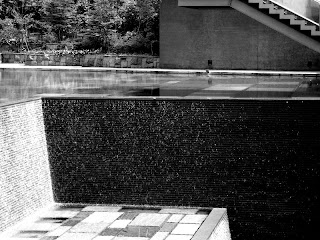
Waterfall made from ceramics tiles and pieces from the local artists.


Looking south over the waterfall.

The observation tower, high on the hill above the complex.

View from the obsrvation tower.


The teahouse on the east side of the complex.

INSIDE THE GALLERIES


Thursday, May 28, 2009

UNCLE HAYATO'S STORY CORNER: THE LEGEND OF TAJIMI-SHI


THE LEGEND OF TAJIMI-SHI


Once upon a time, people in Tajimi-shi were experiencing incredibly hot weather daily. The rice paddies were dry, baked brown by the long drought. As time went on, the people grew more and more unhappy and wondered what they could possibly do to bring rain again to their valley. They prayed daily, sometimes all day, to the Kappa known as the God of Water. (A Kappa by the way, is an imaginary being (well maybe and maybe not) with a large dish on his head). The constantly beat on drums and the priests and people did many rituals in the hope that rain would come.
Eventually the sky began getting dark and it started to rain. In fact, it rained very hard indeed. And because of the heavy rain, the rice grew again and the residents of Tajimi-shi grew other crops in great abundance from then on, harvesting them each autumn and celebrating with a great festival.
But, as generations passed, the people showed their gratitude to the Kappa less and less. Tradition had to make way for progress and the shrine and alter that the people had built in honor of the Kappa was moved to the far end of the Toki River. The Kappa saw this and grew very angry at their disrespect. As punishment for their lack of care, the Kappa brought down a major disaster on the people of Tajimi-shi – a great and terrible flood – and the people suffered great losses.
The people of Tajimi-shi then called on Ryujin-sama, the God of Dragons, to end the Kappa’s anger and stop the floods. The dragon, Ryujin-sama, quickly appeared and broke the dish that was on the Kappa’s head. Suddenly, all of the floodwaters were sucked into the Kappa’s now broken dish, and the floods stop. The kappa then realized how childish he had been and what he had done. He apologized to Ryujin-sama and in return, the dragon gave a new dish to the Kappa and the decided to be friends and together drank sake. Thus, the Kappa made peace with the dragon and he promised, “ I will never again make big floods.” In return, the dragon allowed the Kappa to live in the Toki River.
Now, there are many eels (unagi) in the Toki River. The residents of Tajimi-shi, many of whom now made pottery for their living, at eels. It seems that because they ceramic pottery workers had to work beside kilns of incredibly high temperatures, the needed great strength; and eating eels, it is known, gives great physical strength. Well, eventually the Kappa who was now also living in the Toki River, got to eat unagi and he and the people of Tajimi-shi and he got along quite well from then on.
The mascot of Tajimi-shi is named Unagappa, a combination of kappa and eel. Unagappa likes to meditate at the Kokeizan Eihoji temple, a truly beautiful and peaceful place. He loves classical music and his hobby is eating really yummy foods. His body is colored orange, and in case you happen to see one, it is said that if his body is touched by any person or he becomes wet, his body sparkles with all the colors of the rainbow. Well, perhaps you will never meet the real Unagappa, but you will see his picture all over Tajimi-shi: on billboards, store windows, even official documents at Tajimi-shi City Hall. Unagappa is just one of the charming things about living in Tajimi-shi.

Tuesday, February 3, 2009

LET'S GO SKIING!

SKIING IN GIFU


It’s winter and time for winter sports! Do you like to ski? Then you should come to Gifu! Our ski season is from December 6 until 5 April so there is lots of time to go out and play in the snow! Probably the largest and most popular place to ski in Gifu Prefecture is Dynaland. This place is great, with 19 ski runs that cover all levels of skill from beginning to the most advanced and snowboards are most welcome if you are that crazy!. From here also you can take a quick trip to Takasu Snow Park, which is also quite fun!


In addition to Dynaland, there is also Kawaba Ski Resort, Norn Minakami, and Hotel Villa Monsait and all of these resorts offer great prices and accommodations.


So put on your long underwear, extra sox, and warm clothes and come out and visit us! For more information visit their website at:

http://www.snowjapan.com/e/spotlight/dynaland.html


Hope to see you on the slopes!


Sunday, December 7, 2008

NAGARAGAWA NO UKAI - CORMORANT FISHING IN GIFU


NAGARAGAWA NO UKAI- CORMORANT FISHING

Gifu Nagaragawa no ukai (ぎふ長良川の鵜飼,) or cormorant fishing on the Nagara River in Gifu is a 1,300 year-old tradition and has played a key role in the history of the city of Gifu in Gifu Prefecture, Japan. Through the city’s history, ukai or seasonal cormorant fishing has existed as a means to live, then a profitable industry, to a major attraction for tourists to the region.


The masters of ukai, known as ushō (鵜匠) use cormorants[1] to catch fish, primarily the variety known as ayu[2] or (sweetfish). It takes incredibly great skill to master the art of fishing using cormorants rather than nets or rod and reel, and because of this, the masters at Gifu have received the official title of “Cormorant Fishermen of the Imperial Household Agency,” a title which is passed down from father to sun. Now days, only a few people are actually authorized to do ukai as it is a “protected” occupation under the Imperia Household.

We well know that throughout history man has teamed up with animals to aid in the hunting and gathering of food. On the Nagara River, the teaming of man and cormorant for fishing began over 1,300 years ago as a way for the people of the region to feed their families. As society in Japan grew more cohesive, the cormorant fishing activities came to be under the control of the Imperial Household Agency and the first fish caught each year were sent to the capitol at NARA and later to Kyoto. As noted before, the fishing activities still remain under the Imperial Household Agency and thus the Nagara River has become a protected river, ensuring its cleanliness and productivity for generations to come. The birds themselves have had an impact on the whole of Japanese lore and tradition. The term unomi (鵜呑み) or “swallow whole like cormorant” or in a more contemporary context “accept without question” is attributed to these special birds who swallow fish whole without choking or being injured by the fins or scales.


As Japanese society grew and evolved through time, techniques for ukai improved and what was a local activity grew into an industry. Processing plants grew up in the area and thus the fish could be sold over much greater distances than ever before.

Unfortunately, as the country grew, over-fishing, the arrival or development of new fishing methods and modern transportation saw a decline in ukai as it had once been. Cormorant fishing however continues in Gifu despite the decline in ukai as an industry and has found a new niche for itself, that of a major tourist attraction which brings thousands of people from Japan and around the world to the city. One of those tourists over time was the Japanese poet Matsu Bashō[3] who found himself so enamoured with what he saw that he was moved to write:

おもしろうてやがて悲しき鵜舟哉。

exciting to see
but soon after, comes sadness
the cormorant boats

又たぐひながらの川の鮎なます。

once more to describe
the Nagara River’s own
sweetfish namasu[4]


Since ukai is a daily activity for the nearly five months of the season, the fishing masters begin each day by selecting ten to twelve cormorants for the day’s work. When the birds have been selected and the boats have been prepared, the fishing masters draw lots to determine the order in which they will fish.

Ukai fishing is carried out as a “team effort”, not just between bird and human, but ukai fishing usually requires at least three crewmen on each boat. The leader of the team is known as an usho, who guides and handles the cormorants as they go about their work. The usho is joined by the nakanori (中乗り) or “middle rider” and the tomonori (共乗り) or “companion rider”, who pick up the fish that are caught, paddle the point and guide the rudder/oar.

Cormorant Boat Facts and Terms


Fishing is done from a small flat-bottomed boat called an ubune, specially designed to navigate the shallow water of the river where the fish are easier to catch. Each boat is about 13 meters (43 feet) in length. The boats are paddled out into the river after dark and upstream of the fishing area, although you may also see the boats towed upstream by a powerboat as well. As the boats begin their fishing run, the fishermen attract the fish by lighting bright burning fires of split pine (matsuwariki (松割木)) in metal baskets (kagari (篝)) suspended from the front of the boat on a pole (kagaribō (篝棒)). Actually, the fire is both to light the path of the boat, makes it easier for the cormorants to find the fish, and also to attract the fish to the boats. The light is supplemented by either the beating of a drum or of an oar on the side of the boat.

Cormorant boat: birds and human crew of three. Each of the three crew members has different role. As well as the full- fledged usho, or cormorant fishermen, there is a nakanori (assistant) and a tomonori (helmsman).
Ubune (cormorant boat)About 13 meters long, the boat carries a complement of three: the usho, nakanori, and tomonori.KagaribiThe fire that provides light for cormorant fishing.KagariThe iron basket fire that holds the fire.Kagari-boThe kagari is suspended from this pole.Matsu-wari-kiSplit-pine firewood for the fire basketTanawaThe leash rope that is used to control a cormorant. An usho controls ten to twelve birds at the same time.Tomonori the helmsman, who is responsible for maneuvering the boat.NakanoriThe nakanori assists the usho.

Fishing With Birds

The birds are then sent out into the water to do their job. Each cormorant is on a leash or rope (tenawa) and it takes special skill on the part of the usho to prevent the leashes from becoming entangled as the birds dive and then dive again for their fish. The leash is attached to a small metal ring that is attached around the base of the bird’s neck, but of course, it does not harm the birds at all. Each time a cormorant catches a fist and swallows it, the usho pulls them back into the boat using the ropes attached to their bodies and removes the fish – the ring around their neck is too small to allow the bird to swallow a fish the size the fishermen want, but it does not prevent them from eating smaller fish, which seems to work out quite well for both fisherman and bird. Worthy of note is the fact that although the ropes attached to the cormorants are strong, the fishing master is able to quickly break it if a bird’s rope gets caught beneath rocks or such, ensuring that the bird will not drown. Fishermen care very much for their birds.
Watching Cormorant Fishing

When you come to Gifu, there are several options available for viewing ukai. Visitors can contact the Cormorant Fishing Viewing Boat Office to either rent a private boat, which holds between 15 and 50 people or to buy tickets for one of the general viewing boats. The boats are boarded at the viewing office and then they are steered upriver before landing on the shore of the river for ukai viewing.

Visitors usually board the boats at about 6:30 pm and many boats offer visitors a chance to eat before arriving at the viewing destination at about 7:45 pm. Boats return to the docks at about 8:30 pm or 9 pm.

Visitors are also able to watch cormorant fishing for free from the Cormorant Fishing Viewing Zone on the Nagaragawa Promenade. This area provides visitors with both a place to thee the traditional event as well as to take a rest while strolling along the river. A very romantic evening!

In addition to the ukai boats and viewing boats, there are other boats which play a role in the evening as well. The first boat of the evening is the dancing boat or odoribune which usually has five dancers on the boat while it goes up and down the river entertaining the visitors before the night’s fishing begins. There are also refreshment bots from which to buy snacks and drinks and fireworks to use before cormorant fishing begins.

How To Get There

Board a bus operated by the Gifu Bus Company at either JR Gifu Station (Bus Platform 11) or at Meitetsu Gifu Station (Bus Platform 4), heading towards the Nagara area and get off at Nagarabashi. The ride should normally take about 15 minutes. The Cormorant Viewing Boat Office is located near the western base of Nagara Bridge on the southern side of the river.


[1] The Japanese cormorant (phalacrocorax capittatus), also known as “Temminck’s Cormorant”, is a bird native to East Asia covering a range from Taiwan northward through Korea and Japan to the Russian Far East. It has a black body with a white throat and cheeks and a partially yellow bill.
[2] The ayu (香魚) or sweetfish (plecoglossus altivelis) is a relative of the smelt and dwells in rivers, lakes and coastal waters of western Hokkaido southward to Taiwan and China. The name “sweetfish” is due to the sweetness of its flesh. The ayu is Gunman Prefecture’s “prefectural fish”.

[3] Matsuo Bashō (松尾芭蕉, Matsuo Bashō 1644 – November 28, 1694) was the most famous poet of the Edo period in Japan. During his lifetime, Bashō was recognized for his works in the collaborative haikai no renga form; today, after centuries of commentary, he is recognized as a master of brief and clear haiku. His poetry is internationally renowned, and within Japan many of his poems are reproduced on monuments and traditional sites.
[4] Namasu is a pickled delicacy made from sweetfish

Cormorant Fishing


Copyright 2008 by Hayato Tokugawa


Tuesday, November 18, 2008

LET'S VISIT GIFU CASTLE!


LET'S VISIT GIFU CASTLE!


Europe boasts of its medieval castles and advertises them as great places to visit for tourists. Indeed, if we think about trips to Europe, especially the UK, France, and Germany, we are almost certain to include one or two castles in our plans. Castles are part of European history and culture. What many people don’t know, is that just as in Europe, castles are part of Japan’s history and culture as well, and Gifu Prefecture features one of the grandest!


Gifu Castle (岐阜城,) or Gifu-jō is a mountaintop castle (not at all unlike most European castles) located within the city of Gifu and it is one of the main symbols of the city as well as Gifu Prefecture. It was originally built by the Nikaidō clan[i] between 1201 and 1204 AD during the Kamakura Period[ii]. It was originally called Inabayama Castle (稲葉山城) and has undergone many repairs over the course of countless generations, and through those generations, the castle has accumulated a sizeable history as well.

As formidable as it appears and as famous as Gifu Castle is as a symbol of power and strength, it was once taken over by a group of only sixteen men. There is actually one incident in its history when it was in effect taken or captured by just one man! That man, Takenaka Hanbei went to the castle under the pretext of visiting his sick brother, Saitō Tatsuoki. In fact, he actually went there to kill his brother. When Hanbei attacked him, Tatsuoki was shocked, amazed and confused. He actually believed that an enemy army had come to attack him and fled into the night, leaving Hanbei able to lay claim to Gifu Castle with total ease!

Later on, Hanbei actually returned the castle to his brother, but by then Tatsuoki’s reputation had suffered immense damage. When Oda Nobunaga[iii] later attacked the same castle, many of Tatsuoki’s men remembered the previous incident and abandoned their posts, enabling Nobunaga to easily defeat Tatsuoki and claim Gifu Castle for his own. It was actually Nobunaga who renamed the castle “Gifu-jō” in keeping with the example found in Chinese culture, which was often adopted by Japanese culture. He then proceeded to renovate the castle, making it into something far more impressive than it had been. A Catholic Jesuit missionary from Portugal, Luis Frois, was invited to the castle by Nobunaga and in his writings of his time in Japan, had nothing but praise for the beauty of Gifu Castle.


It was in 1600, that the castle played what is perhaps its most important role. The Battle of Gifu Castle served as a prelude to the Battle of Sekigahara, the end of one era (Sengoku) and the beginning of another, the Tokugawa Period. That same year the castle was destroyed and a part of the structure was actually brought to Kanō Castle[iv] in the south to fortify that structure.

Regrettably, the current version of Gifu Castle is a cement structure that was built in the 1950s, the previous castle having been destroyed by fire bombings of Gifu during World War II. Some tourists complain that the interior is sterile and not in keeping with tradition, which may indeed be true, but consider its fate during the war and what resources (material and economic) were available in Japan at the time of its restoration. It is an imposing structure and within the current castle there are three floors with exhibits that represent the castle’s past, with maps, weapons, pictures and other artifacts for visitors to see and thus, recreate for themselves the story of Gifu-jō. On the top floor is an observation deck, which is open to the public and provides a fantastic view of the surrounding area including the Nagara River and Nagoya. At various times during the year the castle is also open to night viewing from the deck – something that should not be missed.

Near the castle, only a short walk (maybe 70 – 80 m) is a small museum and archive that contains even more artifacts from Gifu Castle and admittance to the museum is included in the admission fee to the castle itself. Also contained in the museum, which also contains pictures of castles throughout Japan, on the second floor, is a museum of musical instruments from Japan (historic and contemporary).


Hours of Operation are:

March 16 - May 11 9:30 am - 5:30 pmMay 12 to October 16 8:30 am - 5:30 pm October 17 - March 15 9:30 am - 4:30 pm[Panorama night view]July 14 to August 31 5:30 pm - 10:00 pmSaturdays and Sundays and public holiday on September 1 to October 14 5:30 pm - 9:30 pmOctober 15 to November 30 4:30 pm - 6:30 pm

Next time, we will visit Gifu Park and take a look around there!


[i] The Nikaidō clan (二階堂氏, ) were Japanese daimyo who ruled over Iwase in Mutsu Province during the Sengoku Period and were descendents of Fujiwara no Muchimaro, the founder of the southern courts of the Fujiwara clan.
[ii] The Kamakura Period (鎌倉時代), 1185 – 1333 AD, was a period of Japanese history marked by the domination of the country by the Kamakura Shogunate, which was official started in 1192 by the first Kamakura Shogun, Minamoto no Yoritomo. The period ended in 1333 with the destruction of the Shogun’s government and re-establishment of imperial rule.
[iii] Oda Nobunaga (織田 信長, Oda Nobunaga), June 23, 1534 – June 21, 1582, was a major political and military leader during the Sengoku Period in Japan. He was the second son of Oda Nobuhide, a deputy military governor in Owari Province. Nobunaga lived a life of almost continuous military activity, eventually conquering over one-third of Japan’s daimyo and in effect unifying Japan, before his death in 1582.
[iv] Kanō Castle (加納城) was a castle built during the relative peace of the 15th and 16th centuries, but only its ruins remain today in the city of Gifu.


The View from Gifu Castle


How To Get there!


Tuesday, November 11, 2008

TAJIMI FALL FESTIVAL

TAJIMI FALL FESTIVAL


Right around the beginning of November (this year November 3) is the Tajimi Festival in Gifu Prefecture. This is a celebration of the town’s cultural and historic heritage as well as a celebration of the end of hot summer days. Quite literally, the entire town turns out for this celebration highlighted by a parade through the “downtown” area with marching bands, groups, samurai, bushi, beautiful Heian period ladies, and cute cute anime characters! It really is a lot of fun and sometimes it seems that there are more people taking part in the parade than are watching it! All ages from babies to seniors! It’s a lot of fun and if you are in or near Tajimi in November, please come by and see us and if you want, you can even take part in the fun!


Culture and history are very important to all of us in Gifu Prefecture and in Tajimi, and there are many cultural events all year. One thing that you might find a bit unusual is the high level of community participation in these events. The entire community comes together to take part in the cultural events of the area. November 14 – 16 is the 66th annual Tajimi Art Exhibition and February 17 –22 is the 42nd Literature Fair! Also in March, (29th and 29th) is the Flea Market Fair and anyone can come and sell their handmade arts and crafts! Everyone, as I said, takes part, from preparation, to exhibitions, to even teaching special classes and leading special events.
You might also want to visit these links!

Lately the local Walking Fair has been in progress. Here are some of the events that we have and when you come to visit us, you can take part in!

October 4: Ikeda Museum and Shimo Kaido Street exploration

October 14: Visiting historic spots in Kasahara City

October 22: Watching autumn flowers and colorful autumn leaves around Mt. Kokei

October 25: A walking exploration of the local world of pottery and ceramics

November 5: A nature and history walk around Kasahara City

November 9: A nature walk to appreciate and celebrate autumn around Mt. Miyama

November 15: Enjoying the “slow life” by taking a relaxing, slow-paced nature walk around Mt. Kokie.

Everyone who participates in this Walking Festival is given a card at the beginning of the event and if you can walk even one kilometer, you get a stamp on your card. If you get a stamp for each event through October and November you win a prize and your name is listed in a booklet published by the City of Tajimi!

Also going on at the same time is the annual Japanese Paper Doll Festival!

Right now Tajimi is looking for pupils and teachers for upcoming events such as:

A class to make a personal seal (honko) from an eraser
A class about star gazing
A class to study about the planet Jupiter
A class on making a bamboo spear
A bird watching class
A class on the enjoyment of Yoga for the entire family
A class on cultivating and harvesting sweet potatoes


So as you can see, there are lots to see and do in Tajimi: Autumn, winter, and spring! Why don’t you come and join us in the fun!