Showing posts with label tajimi travel. Show all posts

Sunday, January 10, 2010

DONDO-YAKI IN ICHINOKURA, TAJIMI CITY, GIFU

It’s early morning and the sky is sunny, the air fresh and crisp as the residents of Ichinokura, part of Tajimi City in Gifu Prefecture, begin to filter into the local school grounds, to gather together around a blazing fire to warm themselves, eat, sing, and enjoy good company! What’s the occasion? It’s Dondo-yaki in Ichinorkura.

The day is also called “Small New Year’s Day” and outside the main urban centers of Tokyō and Ōsaka, in what might be more properly be called “mainstream Japan,” in almost every town and village, people come together to celebrate the New Year.

Dondo-yaki has its origins in the Sagi-cho Matsuri, celebrated for the first time at New Years in the late 16th century and organized in grandiose fashion by the “Great Unifier” Oda Nobunaga, who himself wore makeup and danced in the original celebration. While still celebrated in January in some parts of Japan, such as in Kamakura, Sagi-cho as a separate festival, has typically been moved to mid-March in order to assure good weather and a much larger, extravagant festival; the largest of which is celebrated in Omihachiman-shi, Shiga Prefecture. Yet, Dondo-yaki traces its origins even further back in time than the “Warring States Era;” back to ancient Izumo, in Shimane Prefecture: a town which lies at the core of ancient Japanese history and the foundations of Shintō.[i] According to tradition, a kami (god) named Toshitokujin, the goddess with responsibility for auspicious directions and happenings for the coming year (and when happy, insures an abundant harvest to come) visits during the New Year’s season, to announce the arrival of Shōgatsu-sama (literally, “Honorable New year”). The celebration is regionally known by several different names, including Onbe-yake, Kangari, and Saito-yaki, but by and large, is best known as Dondo-yaki.

New Year’s traditions run deep in Japan and begin on December 31. Many Japanese wives and moms however, will attest that the traditions begin well before the 31st, with the traditional New Year house cleaning (at times an awesome undertaking) and the cooking of traditional Japanese foods for the coming holidays. Wise men and husbands absent themselves during this period or else find themselves in forced domestic labor.


One of the primary traditions linked to Dondo-yaki is the burning of New Year’s decorations such as kadomatsu, shimenawa, and Omomori. A kadomatsu (門松) (literally “gate pine”) is a traditional New Year decoration which is placed in pairs in front of homes shortly after Christmas, with the intention of welcoming ancestral spirits or kami and acting as temporary housing for them; in particular Toshitokujin, who will bring a bountiful harvest and confer the blessings of ancestors on everyone

A Kyoto-style kadomatsu.

Designs vary depending on the region; however, by and large they are made of pine, bamboo, and sometimes sprigs from ume (plum) trees, which represent longevity, prosperity and dedication.


Simenawa adorn every village street at New Years.

Shimenawa (標縄 ) or “enclosing rope) are lengths of sacred ropes, made of rice straw, used for purification in Shintō, which at New Years are hung across the tops of gates marking then entryway to a house or the front door of a home to indicate a pure space and thus to ward off evil. Often shimenawa are decorated with shide (紙垂 ), zigzag shaped paper streamers, another symbol of purification.

Omamori (お守り) are charms, good luck charms, dedicated to particular Shintō and Buddhist deities. The word mamori means protections, and Omamori means “honorable protector.” On Dondo-yaki, the town or village gathers at some central place and burn all these sacred symbols for the greeting of the New Year in a traditional bon fire. By burning these decorations, they are then sent off to the gods as gifts.

Another tradition of Dondo-yaki is connected to the art of Shodō, or Japanese calligraphy. Kakizome (書き初 ) or “first writing” is a term for the first calligraphy written at the beginning of a year, traditionally done on January 2). Kakizome are done using ink made from the first water drawn from a well on New Year’s Day. Seated and facing in an auspicious (favorable) direction, the calligrapher writes poetry that contains equally auspicious words and phrases, such as “long life,” “spring,” or “endless youth.” In Japanese schools, children are assigned kakizome as homework over the winter holidays. Usually the assignment consists of writing auspicious kanji (characters) rather than entire poems. At the Dondo-yaki celebration, the kakizome papers are burned in the same fire as are the New Years decorations. Tradition says that if the burning paper flies high, then the person who created the calligraphy will be able to write even better in the coming year.

Aside from the religious traditions associated with Dondo-yaki, what makes the occasion so special and fun, is the sense of community. In Ichinokura, for example, the entire town comes together for the celebration. The sense of community, so common throughout mainstream Japan, is incredibly strong and something that the West could take note of. People come to celebrate the New Year with music, dance, games, conversation, and food; everything, including the food, is free! The event is planned and organized on a community level with the entertainment, food and labor provided by the residents of the town.

Keeper of the "Sacred Fire"


The Ichinokura Shobo Dan. Our equivalent
to American volunteer fire departments. They are
all Ichinokura residents who volunteer for fire
service and work alongside Tajimi firemen
whenever there is an emergency call for service.


On days like this, the local police station is closed. Then
again, it's closed everyday - the local crime rate
is so low, we don't need police!


Ichinokura Taiko Dan, taiko group.


Want to eat? Just bring your own bowl and hashi (chopsticks) – there is no charge for the rice cakes, Japanese barbeque, grilled fish, zenzai (red bean soup) and other fantastic delicacies. Zenza, also known as oshiruko (お汁粉 ) is a traditional Japansese dessert. It is a sweed porridge of azuki beans, boiled and crushed, served in a bowl with mochi (rice cakes), dumplings, or even chestnuts, and perhaps topped with sweetened condensed milk. It’s loved by many Japanese, especially during the winter and the New Year celebration. Want saké, bring a cup: there’s plenty of New Years saké for everyone.

Cold but happy members of one of the
local food committies.

Grilling rice cakes on a cold winter morning -
very tasty and warming!


Grilled fish! Yum!

Almost everyone in town turns out
for the free food and entertainment.


There's plenty of sake to go around!
If you are going to visit our beautiful prefecture of Gifu-ken at New Years, please make sure to visit one of our local Dondo-yaki celebrations and enjoy some of the true spirit of Japan and the Japanese people. Oh, and bring a bowl, hashi, and a large cup!


[i] For more information on Shinto and traditional Japanese festivals, customs, and celebrations, there is a wealth of information available in Glimpses of an Unfamiliar Japan, Volumes I and II, by Lafcadio Hearn.
Copyright 2010 by Tokugawa Hayato and Shisei-Do Publications. All Rights reserved.


Saturday, November 7, 2009

THE POTTERIES OF SETO

I happened to find the following article quite by accident while doing research for several projects for our publishing company, Shisei-Dō Publications, here in Japan. The following article by Basil Hall Chamberlain[i] was part of his A Handbook for Travelers In Japan, (Also known as the Handbook to the Japanese Empire) first published in 1891 (this is from the 1894 revised editon) as part of the then extremely popular and famous travel guides published by John Murray[ii].
This brief article relates to the famous pottery region of central Honshū, which includes Mono, Tajimi, Ichinokura, and surrounding area, our home. Several references are made to places we noted in previous essays on this blog and we invite you to read them as well. For us it was fun to read about our area as recorded in the middle of the Meiji Era. We hope you will find this essay by Chamberalin both informative and entertaining.


ROUTE 31.

THE POTTERIES OF SETO.


The province of Owari of which Nagoya is the capital, and the adjacent province of Mino, have for many ages been flourishing centers of the porcelain industry, the most famous seat of which is at Seto, where Katō Shirozaemon, the first great master of Japanese ceramic art, set up his kiln about the year 1230 on his return from six years of diligent study in China. Thenceforth Seto became the headquarters of the manufacture of dainty little jars, ewers [pitchers], and other utensils for the tea ceremonies (cha-no-yu), so that the word seto-mono literally “Seto things,” has come to be employed in Japanese as a generic name for all pottery and porcelain, much as the word “china” is used in English. Seto has remained the chief porcelain manufactory of Japan. Many of the pieces now turned out – especially the monster blue-white vases – are intended only for the foreign market. This locality suffered terribly from the great earthquake of 1891; for though the houses remained standing, the kilns and entire stock were smashed.
Persons whose time is limited can witness the process of porcelain manufacture at Matsumora’s establishment in Nagoya. Those with a day to spare should visit Seto, 5 ½ ri (13 ¼ miles) from that city along a flat and excellent jinrikisha road.


Seto (no inns) is a general name for the four hamlets of Kita Shingai, Minami, Shingai, Gō, and Hora, situated on low hills that surround an almost circular valley. About eighty households are engaged in the manufacture of porcelain, and seventeen or eighteen in that of common pottery. The clay is found in the immediate neighborhood, the silica being brought from Sannagi in the northwest corner of Mikawa, about 3 ri distant. A large proportion of the common pottery that goes under the name of Seto ware comes from Akuzu, about 1 ri further up the valley to the east. The establishments best worth visiting are those of Katō Mokuzaemon, Katō Shigejū, and Katō Masukichi in Kita Shingai, and Katō Gosuke in Minami Shingai, the latter being noted for his translucent white ware, chiefly sake cups. The Tōki-kwan at Minami Shingai is a bazaar for all the wares of the neighborhood. There are numerous smaller houses, - indeed the villagers carry on no other trade. Katō Gosuke owns another and larger manufactory at Tajimi, a village about 2 ½ ri from Seto, not accessible by jinrikisha [rickshaw], here is produced the finest porcelain in Mino, with delicate decorations in pale blue, obtained from the native cobalt known under the name of konjō. A darker shade is derived from an impure cobalt imported from China, and called by the potters kyūgosu. Our word cobalt has been corrupted by them into koharu, and this term is employed to denote the pigment obtained from Europe.

In the near vicinity of Nagoya are various smaller villages devoted to the production of minor kinds of porcelain and pottery, such as the Ofuke-yaki, Yosamu-yaki, Fujimi-yaki, Toyoraku-yaki,, and Inugayama-yaki. Course earthenware is made at Taokonabe, 10 ri to the south of Nagoya, near Taketoyo.


NOTES


[i] While many companies have published wonderful travel guides to all places imaginable, the contribution of Murray’s, particularly to 19th century readers, was outstanding. The Murray family publishing dynasty was actually founded in 1768 by John Murray, a former officer in the Royal Marines, who never cold have imaged that six generations of his descendants (all named John Murray) would create one of the greatest of British publishing houses ever. The line of literary giants who passed through their doors and onto their presses included Jane Austen, Lord Byron, Walter Scott, Washington Irving, Charles Darwin, Herman Melville, Sir Arthur Conan Doyle and on and on.
It was the third “John Murray” who launched the famous “Murray’s Handbooks” in 1836, the immensely popular series being the forerunner of the Lonely Planet” series of our time.
[ii] Basil Hall Chamberlain (October 18, 1850 – February 15, 1935) was a professor at Tokyo Imperial University and one of the foremost British Japanologists in Japan during the Meiji Era of the late 19th and early 20th centuries, contemporaries of E.M. Sato, And W.G. Aston as well as a close personal friend and confident of Lafcadio Hearn. He also is noted for some of the earliest translations of haiku into English, although he is best remembered for is popular one-volume encyclopedia Things Japanese, first published in 1890.


Copyright 2009 by Hayato Tokugawa and Shisei-Do Publications.

Thursday, July 2, 2009

WALKING AROUND ICHINOKURA-CHO I.

Ichinokura-cho, part of the larger Tajimi-shi (Tajimi City) is surrounded by hills and mountains, covered by trees that are green all year long. It is peaceful, quiet, with clean air, and crime is almost unheard of. It's a great place to just walk around and see what can be seen.

Much of the outlying areas of Ichinokura-cho are agricultural, with small family farms that produce wonderful fruits and vegetables as well as rice.

Everything is green here, all year long!

A small neighborhood.


A Japanese maple tree that wants to glow red all year long!

Here is another read maple, in front of an old and beautifully maintaned "samurai house". This particular house belongs to a local ceramic artist who is regarded as a "living national treasure". The house has a beautiful garden, much of which can be enjoyed from the street.


Part of another old "samurai-style" house.


One of Ichinokura-cho's narrow, extremely clean, quiet streets. There is hardly any traffic so it is a pleasure to take a walk and see what can be seen!

A small house/shop with a great potted plant garden in front!
Typical houses in a typical Ichinokura neighborhood.


A view of part of Ichinokura-cho, right after a gentle spring rain. Everything is peaceful and quiet and the air is so clean!


The "Bunny House". Each window in this neighborhood home as a plush, stuffed bunnie in it!
A typical street and homes, on a rainy spring morning.


Oribe Street - the main street through "Downtown Ichinokura" where you can find many interesting shops and ceramic art galleries.


Friday, June 12, 2009

MINO CERAMIC PARK, TAJIMI, GIFU PREFECTURE


MINO CERAMIC PARK, TAJIMI

Japan probably has the largest number of ceramic museums in the world. There are some incredibly fine museums dotted throughout the country both arge and small; some devoted toa single potter while other cover one particular style or region. There are also many museums that fall somewhere in between.

In 2002, a new ceramic museum opened in Tajimi as part of the larger Ceramic Park complex, just a short drive north from the JR Line's Tajimi Station, and just down the road from the Gifu Prefectural Ceramic Museum. In the Ceramic Park complex is the wonderful Museum of Modern Ceramic Art, hwich I recently visited. The museum building, designed by Arata Isozaki, compliments its natural surroundings and gives the visitor a feeling of being quite close to nature. focused on the theme of modern ceramic arts, the museum collects modern and contemporary ceramic works from within Japan and around the world. The museum's goal is to hold a variety of exhibitions and events in the future. In order to promote a new culture of ceramics, the museum also plans to collect and exhibit utilitarian ceramics, an area much overloked by other museums, as well as industrial ceramics from the area of modern design.


The museum is set on the side of a hill and is possibly one of the finest ceramic museums in the world with its natural lighting and large rooms intermixed with smaller galleries. the building is set in the side of a hill and is largely below ground. A lovely cascade of water flows outside and creates a delightful, refreshing and peaceful scene. Certainly it is a wonderful place just to sit and enjoy the surroundings and quite nice for a picnic as well.


Before one getts to see any of this however, one must take a walk through a long ceramic tunnel, the ceiling of which is covered with ceramic shards which look as if they might fall at anymoment; yet, it does not appeary shoddy in any way.


There are various levels (down) there is an excellent gift shoop, galleries, and classroom areas wehre visitors may take classes in the making of ceramic art.


The main entrance to the Ceramic Park complex from the highway.


The main parking lot and entrance to the complex.


The covered walkway/bridge to the main complex. Shards of ceramics line the ceiling.

The main entrance to the museum and gift shop.

An expensive uribe ash try. There are many of these spread throughout the complex.

Part of the lower waterfall and park area.


Covered walkway leading to the reflecting pond.
At the far side is a teahouse for tea ceremonies.

View of a corner of the reflecting pond from oneof the many covered walkways.

The central area of the complex and reflecting pond.
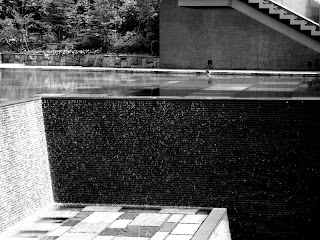
Waterfall made from ceramics tiles and pieces from the local artists.


Looking south over the waterfall.

The observation tower, high on the hill above the complex.

View from the obsrvation tower.


The teahouse on the east side of the complex.

INSIDE THE GALLERIES