KUMANO SHRINE
Friday, August 23, 2013
KUMANO SHRINE I
KUMANO SHRINE
Sunday, September 26, 2010
SHOPPING DAY AT VALOR
Just like in any other town or city, in any prefecture in Japan, and just like any town or city in the USA, we do much of our weekly shopping on Friday or Saturday at our local supermarket and home store. In Tajimi-shi, we like to go to the Valor supamaketto and home store. Valor is a chain of such stores, based in Tajimi which serves Gifu Prefecture among others. The company is quite popoular with everyone and highly successful:
http://www.valor.co.jp/vghp/, http://www.alacrastore.com/company-snapshot/Valor_Co_Ltd-1079290
Fridays and Saturdays are particularly busy, a time when not only young families come to shop but also middle-aged and elderly couples as well. If you visit Gifu, and particularly Tajimi-shi, you owe it to yourself to visit Valor. You will be amazed at the wide variety of foods and goods available in both the grocery market and the home store, and the prices are often much better than in the US. You'll be amazed. What perhaps will impress any visitor the most is that each store is immaculately clean and the staff are not only helpful, but extremely polite and gracious, always eager to help a visitor.
The front entrance to the Valor supamaketto in Tajimi-shi.
The ever-present security guard, there mostly to direct traffic.
A required stopping place, either before or after
shopping is Mr. Donut for fresh coffee and donuts!
Saturday, November 7, 2009
THE POTTERIES OF SETO
This brief article relates to the famous pottery region of central Honshū, which includes Mono, Tajimi, Ichinokura, and surrounding area, our home. Several references are made to places we noted in previous essays on this blog and we invite you to read them as well. For us it was fun to read about our area as recorded in the middle of the Meiji Era. We hope you will find this essay by Chamberalin both informative and entertaining.
ROUTE 31.
THE POTTERIES OF SETO.

The province of Owari of which Nagoya is the capital, and the adjacent province of Mino, have for many ages been flourishing centers of the porcelain industry, the most famous seat of which is at Seto, where Katō Shirozaemon, the first great master of Japanese ceramic art, set up his kiln about the year 1230 on his return from six years of diligent study in China. Thenceforth Seto became the headquarters of the manufacture of dainty little jars, ewers [pitchers], and other utensils for the tea ceremonies (cha-no-yu), so that the word seto-mono literally “Seto things,” has come to be employed in Japanese as a generic name for all pottery and porcelain, much as the word “china” is used in English. Seto has remained the chief porcelain manufactory of Japan. Many of the pieces now turned out – especially the monster blue-white vases – are intended only for the foreign market. This locality suffered terribly from the great earthquake of 1891; for though the houses remained standing, the kilns and entire stock were smashed.
Persons whose time is limited can witness the process of porcelain manufacture at Matsumora’s establishment in Nagoya. Those with a day to spare should visit Seto, 5 ½ ri (13 ¼ miles) from that city along a flat and excellent jinrikisha road.

Seto (no inns) is a general name for the four hamlets of Kita Shingai, Minami, Shingai, Gō, and Hora, situated on low hills that surround an almost circular valley. About eighty households are engaged in the manufacture of porcelain, and seventeen or eighteen in that of common pottery. The clay is found in the immediate neighborhood, the silica being brought from Sannagi in the northwest corner of Mikawa, about 3 ri distant. A large proportion of the common pottery that goes under the name of Seto ware comes from Akuzu, about 1 ri further up the valley to the east. The establishments best worth visiting are those of Katō Mokuzaemon, Katō Shigejū, and Katō Masukichi in Kita Shingai, and Katō Gosuke in Minami Shingai, the latter being noted for his translucent white ware, chiefly sake cups. The Tōki-kwan at Minami Shingai is a bazaar for all the wares of the neighborhood. There are numerous smaller houses, - indeed the villagers carry on no other trade. Katō Gosuke owns another and larger manufactory at Tajimi, a village about 2 ½ ri from Seto, not accessible by jinrikisha [rickshaw], here is produced the finest porcelain in Mino, with delicate decorations in pale blue, obtained from the native cobalt known under the name of konjō. A darker shade is derived from an impure cobalt imported from China, and called by the potters kyūgosu. Our word cobalt has been corrupted by them into koharu, and this term is employed to denote the pigment obtained from Europe.
In the near vicinity of Nagoya are various smaller villages devoted to the production of minor kinds of porcelain and pottery, such as the Ofuke-yaki, Yosamu-yaki, Fujimi-yaki, Toyoraku-yaki,, and Inugayama-yaki. Course earthenware is made at Taokonabe, 10 ri to the south of Nagoya, near Taketoyo.
[i] While many companies have published wonderful travel guides to all places imaginable, the contribution of Murray’s, particularly to 19th century readers, was outstanding. The Murray family publishing dynasty was actually founded in 1768 by John Murray, a former officer in the Royal Marines, who never cold have imaged that six generations of his descendants (all named John Murray) would create one of the greatest of British publishing houses ever. The line of literary giants who passed through their doors and onto their presses included Jane Austen, Lord Byron, Walter Scott, Washington Irving, Charles Darwin, Herman Melville, Sir Arthur Conan Doyle and on and on.
It was the third “John Murray” who launched the famous “Murray’s Handbooks” in 1836, the immensely popular series being the forerunner of the Lonely Planet” series of our time.
[ii] Basil Hall Chamberlain (October 18, 1850 – February 15, 1935) was a professor at Tokyo Imperial University and one of the foremost British Japanologists in Japan during the Meiji Era of the late 19th and early 20th centuries, contemporaries of E.M. Sato, And W.G. Aston as well as a close personal friend and confident of Lafcadio Hearn. He also is noted for some of the earliest translations of haiku into English, although he is best remembered for is popular one-volume encyclopedia Things Japanese, first published in 1890.
Friday, June 12, 2009
MINO CERAMIC PARK, TAJIMI, GIFU PREFECTURE

Japan probably has the largest number of ceramic museums in the world. There are some incredibly fine museums dotted throughout the country both arge and small; some devoted toa single potter while other cover one particular style or region. There are also many museums that fall somewhere in between.
In 2002, a new ceramic museum opened in Tajimi as part of the larger Ceramic Park complex, just a short drive north from the JR Line's Tajimi Station, and just down the road from the Gifu Prefectural Ceramic Museum. In the Ceramic Park complex is the wonderful Museum of Modern Ceramic Art, hwich I recently visited. The museum building, designed by Arata Isozaki, compliments its natural surroundings and gives the visitor a feeling of being quite close to nature. focused on the theme of modern ceramic arts, the museum collects modern and contemporary ceramic works from within Japan and around the world. The museum's goal is to hold a variety of exhibitions and events in the future. In order to promote a new culture of ceramics, the museum also plans to collect and exhibit utilitarian ceramics, an area much overloked by other museums, as well as industrial ceramics from the area of modern design.
The museum is set on the side of a hill and is possibly one of the finest ceramic museums in the world with its natural lighting and large rooms intermixed with smaller galleries. the building is set in the side of a hill and is largely below ground. A lovely cascade of water flows outside and creates a delightful, refreshing and peaceful scene. Certainly it is a wonderful place just to sit and enjoy the surroundings and quite nice for a picnic as well.
Before one getts to see any of this however, one must take a walk through a long ceramic tunnel, the ceiling of which is covered with ceramic shards which look as if they might fall at anymoment; yet, it does not appeary shoddy in any way.
There are various levels (down) there is an excellent gift shoop, galleries, and classroom areas wehre visitors may take classes in the making of ceramic art.
The main entrance to the Ceramic Park complex from the highway.
The main parking lot and entrance to the complex.
The covered walkway/bridge to the main complex. Shards of ceramics line the ceiling.
The main entrance to the museum and gift shop.
An expensive uribe ash try. There are many of these spread throughout the complex.
Part of the lower waterfall and park area.
Covered walkway leading to the reflecting pond.
View of a corner of the reflecting pond from oneof the many covered walkways.
The central area of the complex and reflecting pond.
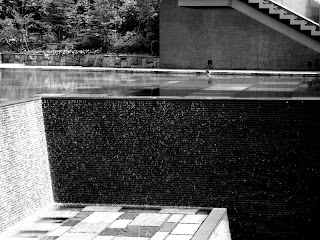
Waterfall made from ceramics tiles and pieces from the local artists.
Looking south over the waterfall.
The observation tower, high on the hill above the complex.
View from the obsrvation tower.

The teahouse on the east side of the complex.
INSIDE THE GALLERIES


Thursday, May 28, 2009
UNCLE HAYATO'S STORY CORNER: THE LEGEND OF TAJIMI-SHI

Once upon a time, people in Tajimi-shi were experiencing incredibly hot weather daily. The rice paddies were dry, baked brown by the long drought. As time went on, the people grew more and more unhappy and wondered what they could possibly do to bring rain again to their valley. They prayed daily, sometimes all day, to the Kappa known as the God of Water. (A Kappa by the way, is an imaginary being (well maybe and maybe not) with a large dish on his head). The constantly beat on drums and the priests and people did many rituals in the hope that rain would come.
Eventually the sky began getting dark and it started to rain. In fact, it rained very hard indeed. And because of the heavy rain, the rice grew again and the residents of Tajimi-shi grew other crops in great abundance from then on, harvesting them each autumn and celebrating with a great festival.
But, as generations passed, the people showed their gratitude to the Kappa less and less. Tradition had to make way for progress and the shrine and alter that the people had built in honor of the Kappa was moved to the far end of the Toki River. The Kappa saw this and grew very angry at their disrespect. As punishment for their lack of care, the Kappa brought down a major disaster on the people of Tajimi-shi – a great and terrible flood – and the people suffered great losses.
The people of Tajimi-shi then called on Ryujin-sama, the God of Dragons, to end the Kappa’s anger and stop the floods. The dragon, Ryujin-sama, quickly appeared and broke the dish that was on the Kappa’s head. Suddenly, all of the floodwaters were sucked into the Kappa’s now broken dish, and the floods stop. The kappa then realized how childish he had been and what he had done. He apologized to Ryujin-sama and in return, the dragon gave a new dish to the Kappa and the decided to be friends and together drank sake. Thus, the Kappa made peace with the dragon and he promised, “ I will never again make big floods.” In return, the dragon allowed the Kappa to live in the Toki River.
Now, there are many eels (unagi) in the Toki River. The residents of Tajimi-shi, many of whom now made pottery for their living, at eels. It seems that because they ceramic pottery workers had to work beside kilns of incredibly high temperatures, the needed great strength; and eating eels, it is known, gives great physical strength. Well, eventually the Kappa who was now also living in the Toki River, got to eat unagi and he and the people of Tajimi-shi and he got along quite well from then on.
The mascot of Tajimi-shi is named Unagappa, a combination of kappa and eel. Unagappa likes to meditate at the Kokeizan Eihoji temple, a truly beautiful and peaceful place. He loves classical music and his hobby is eating really yummy foods. His body is colored orange, and in case you happen to see one, it is said that if his body is touched by any person or he becomes wet, his body sparkles with all the colors of the rainbow. Well, perhaps you will never meet the real Unagappa, but you will see his picture all over Tajimi-shi: on billboards, store windows, even official documents at Tajimi-shi City Hall. Unagappa is just one of the charming things about living in Tajimi-shi.
Tuesday, November 11, 2008
TAJIMI FALL FESTIVAL
Culture and history are very important to all of us in Gifu Prefecture and in Tajimi, and there are many cultural events all year. One thing that you might find a bit unusual is the high level of community participation in these events. The entire community comes together to take part in the cultural events of the area. November 14 – 16 is the 66th annual Tajimi Art Exhibition and February 17 –22 is the 42nd Literature Fair! Also in March, (29th and 29th) is the Flea Market Fair and anyone can come and sell their handmade arts and crafts! Everyone, as I said, takes part, from preparation, to exhibitions, to even teaching special classes and leading special events.
Lately the local Walking Fair has been in progress. Here are some of the events that we have and when you come to visit us, you can take part in!
October 4: Ikeda Museum and Shimo Kaido Street exploration
October 14: Visiting historic spots in Kasahara City
October 22: Watching autumn flowers and colorful autumn leaves around Mt. Kokei
October 25: A walking exploration of the local world of pottery and ceramics
November 5: A nature and history walk around Kasahara City
November 9: A nature walk to appreciate and celebrate autumn around Mt. Miyama
November 15: Enjoying the “slow life” by taking a relaxing, slow-paced nature walk around Mt. Kokie.
Everyone who participates in this Walking Festival is given a card at the beginning of the event and if you can walk even one kilometer, you get a stamp on your card. If you get a stamp for each event through October and November you win a prize and your name is listed in a booklet published by the City of Tajimi!
Also going on at the same time is the annual Japanese Paper Doll Festival!
Right now Tajimi is looking for pupils and teachers for upcoming events such as:
A class to make a personal seal (honko) from an eraser
A class about star gazing
A class to study about the planet Jupiter
A class on making a bamboo spear
A bird watching class
A class on the enjoyment of Yoga for the entire family
A class on cultivating and harvesting sweet potatoes
So as you can see, there are lots to see and do in Tajimi: Autumn, winter, and spring! Why don’t you come and join us in the fun!

