
NAGARAGAWA NO UKAI- CORMORANT FISHING

Gifu Nagaragawa no ukai (ぎふ長良川の鵜飼,) or cormorant fishing on the Nagara River in Gifu is a 1,300 year-old tradition and has played a key role in the history of the city of Gifu in Gifu Prefecture, Japan. Through the city’s history, ukai or seasonal cormorant fishing has existed as a means to live, then a profitable industry, to a major attraction for tourists to the region.

The masters of ukai, known as ushō (鵜匠) use cormorants
[1] to catch fish, primarily the variety known as ayu
[2] or (sweetfish). It takes incredibly great skill to master the art of fishing using cormorants rather than nets or rod and reel, and because of this, the masters at Gifu have received the official title of “Cormorant Fishermen of the Imperial Household Agency,” a title which is passed down from father to sun. Now days, only a few people are actually authorized to do ukai as it is a “protected” occupation under the Imperia Household.
We well know that throughout history man has teamed up with animals to aid in the hunting and gathering of food. On the Nagara River, the teaming of man and cormorant for fishing began over 1,300 years ago as a way for the people of the region to feed their families. As society in Japan grew more cohesive, the cormorant fishing activities came to be under the control of the Imperial Household Agency and the first fish caught each year were sent to the capitol at NARA and later to Kyoto. As noted before, the fishing activities still remain under the Imperial Household Agency and thus the Nagara River has become a protected river, ensuring its cleanliness and productivity for generations to come. The birds themselves have had an impact on the whole of Japanese lore and tradition. The term unomi (鵜呑み) or “swallow whole like cormorant” or in a more contemporary context “accept without question” is attributed to these special birds who swallow fish whole without choking or being injured by the fins or scales.

As Japanese society grew and evolved through time, techniques for ukai improved and what was a local activity grew into an industry. Processing plants grew up in the area and thus the fish could be sold over much greater distances than ever before.
Unfortunately, as the country grew, over-fishing, the arrival or development of new fishing methods and modern transportation saw a decline in ukai as it had once been. Cormorant fishing however continues in Gifu despite the decline in ukai as an industry and has found a new niche for itself, that of a major tourist attraction which brings thousands of people from Japan and around the world to the city. One of those tourists over time was the Japanese poet Matsu Bashō
[3] who found himself so enamoured with what he saw that he was moved to write:
おもしろうてやがて悲しき鵜舟哉。
exciting to see
but soon after, comes sadness
the cormorant boats
又たぐひながらの川の鮎なます。
once more to describe
the Nagara River’s own
sweetfish namasu
[4]
Since ukai is a daily activity for the nearly five months of the season, the fishing masters begin each day by selecting ten to twelve cormorants for the day’s work. When the birds have been selected and the boats have been prepared, the fishing masters draw lots to determine the order in which they will fish.

Ukai fishing is carried out as a “team effort”, not just between bird and human, but ukai fishing usually requires at least three crewmen on each boat. The leader of the team is known as an usho, who guides and handles the cormorants as they go about their work. The usho is joined by the nakanori (中乗り) or “middle rider” and the tomonori (共乗り) or “companion rider”, who pick up the fish that are caught, paddle the point and guide the rudder/oar.
Cormorant Boat Facts and Terms

Fishing is done from a small flat-bottomed boat called an ubune, specially designed to navigate the shallow water of the river where the fish are easier to catch. Each boat is about 13 meters (43 feet) in length. The boats are paddled out into the river after dark and upstream of the fishing area, although you may also see the boats towed upstream by a powerboat as well. As the boats begin their fishing run, the fishermen attract the fish by lighting bright burning fires of split pine (matsuwariki (松割木)) in metal baskets (kagari (篝)) suspended from the front of the boat on a pole (kagaribō (篝棒)). Actually, the fire is both to light the path of the boat, makes it easier for the cormorants to find the fish, and also to attract the fish to the boats. The light is supplemented by either the beating of a drum or of an oar on the side of the boat.
Cormorant boat: birds and human crew of three. Each of the three crew members has different role. As well as the full- fledged usho, or cormorant fishermen, there is a nakanori (assistant) and a tomonori (helmsman).
Ubune (cormorant boat)About 13 meters long, the boat carries a complement of three: the usho, nakanori, and tomonori.KagaribiThe fire that provides light for cormorant fishing.KagariThe iron basket fire that holds the fire.Kagari-boThe kagari is suspended from this pole.Matsu-wari-kiSplit-pine firewood for the fire basketTanawaThe leash rope that is used to control a cormorant. An usho controls ten to twelve birds at the same time.Tomonori the helmsman, who is responsible for maneuvering the boat.NakanoriThe nakanori assists the usho.
Fishing With Birds
The birds are then sent out into the water to do their job. Each cormorant is on a leash or rope (tenawa) and it takes special skill on the part of the usho to prevent the leashes from becoming entangled as the birds dive and then dive again for their fish. The leash is attached to a small metal ring that is attached around the base of the bird’s neck, but of course, it does not harm the birds at all. Each time a cormorant catches a fist and swallows it, the usho pulls them back into the boat using the ropes attached to their bodies and removes the fish – the ring around their neck is too small to allow the bird to swallow a fish the size the fishermen want, but it does not prevent them from eating smaller fish, which seems to work out quite well for both fisherman and bird. Worthy of note is the fact that although the ropes attached to the cormorants are strong, the fishing master is able to quickly break it if a bird’s rope gets caught beneath rocks or such, ensuring that the bird will not drown. Fishermen care very much for their birds.
Watching Cormorant Fishing
When you come to Gifu, there are several options available for viewing ukai. Visitors can contact the Cormorant Fishing Viewing Boat Office to either rent a private boat, which holds between 15 and 50 people or to buy tickets for one of the general viewing boats. The boats are boarded at the viewing office and then they are steered upriver before landing on the shore of the river for ukai viewing.
Visitors usually board the boats at about 6:30 pm and many boats offer visitors a chance to eat before arriving at the viewing destination at about 7:45 pm. Boats return to the docks at about 8:30 pm or 9 pm.
Visitors are also able to watch cormorant fishing for free from the Cormorant Fishing Viewing Zone on the Nagaragawa Promenade. This area provides visitors with both a place to thee the traditional event as well as to take a rest while strolling along the river. A very romantic evening!
In addition to the ukai boats and viewing boats, there are other boats which play a role in the evening as well. The first boat of the evening is the dancing boat or odoribune which usually has five dancers on the boat while it goes up and down the river entertaining the visitors before the night’s fishing begins. There are also refreshment bots from which to buy snacks and drinks and fireworks to use before cormorant fishing begins.


How To Get There
Board a bus operated by the Gifu Bus Company at either JR Gifu Station (Bus Platform 11) or at Meitetsu Gifu Station (Bus Platform 4), heading towards the Nagara area and get off at Nagarabashi. The ride should normally take about 15 minutes. The Cormorant Viewing Boat Office is located near the western base of Nagara Bridge on the southern side of the river.
[1] The Japanese cormorant (phalacrocorax capittatus), also known as “Temminck’s Cormorant”, is a bird native to East Asia covering a range from Taiwan northward through Korea and Japan to the Russian Far East. It has a black body with a white throat and cheeks and a partially yellow bill.
[2] The ayu (香魚) or sweetfish (plecoglossus altivelis) is a relative of the smelt and dwells in rivers, lakes and coastal waters of western Hokkaido southward to Taiwan and China. The name “sweetfish” is due to the sweetness of its flesh. The ayu is Gunman Prefecture’s “prefectural fish”.
[3] Matsuo Bashō (松尾芭蕉, Matsuo Bashō 1644 – November 28, 1694) was the most famous poet of the Edo period in Japan. During his lifetime, Bashō was recognized for his works in the collaborative haikai no renga form; today, after centuries of commentary, he is recognized as a master of brief and clear haiku. His poetry is internationally renowned, and within Japan many of his poems are reproduced on monuments and traditional sites.
[4] Namasu is a pickled delicacy made from sweetfish
Copyright 2008 by Hayato Tokugawa
 Much of the outlying areas of Ichinokura-cho are agricultural, with small family farms that produce wonderful fruits and vegetables as well as rice.
  Everything is green here, all year long!
 A Japanese maple tree that wants to glow red all year long!
 Here is another read maple, in front of an old and beautifully maintaned "samurai house". This particular house belongs to a local ceramic artist who is regarded as a "living national treasure". The house has a beautiful garden, much of which can be enjoyed from the street.
 Part of another old "samurai-style" house.
 One of Ichinokura-cho's narrow, extremely clean, quiet streets. There is hardly any traffic so it is a pleasure to take a walk and see what can be seen!
 A small house/shop with a great potted plant garden in front!
 Typical houses in a typical Ichinokura neighborhood.


 A view of part of Ichinokura-cho, right after a gentle spring rain. Everything is peaceful and quiet and the air is so clean!

 The "Bunny House". Each window in this neighborhood home as a plush, stuffed bunnie in it!
 A typical street and homes, on a rainy spring morning.

 Oribe Street - the main street through "Downtown Ichinokura" where you can find many interesting shops and ceramic art galleries.

 The main entrance to the Ceramic Park complex from the highway.
 The main parking lot and entrance to the complex.
 The covered walkway/bridge to the main complex. Shards of ceramics line the ceiling.
 The main entrance to the museum and gift shop.
 An expensive uribe ash try. There are many of these spread throughout the complex.
 Part of the lower waterfall and park area.
 Covered walkway leading to the reflecting pond.
 The central area of the complex and reflecting pond.
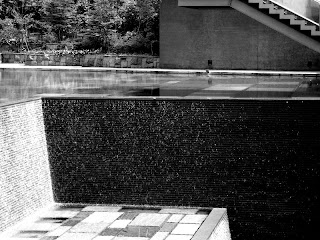 Waterfall made from ceramics tiles and pieces from the local artists.
 Looking south over the waterfall.
 The observation tower, high on the hill above the complex.
 View from the obsrvation tower.


 Posts
Posts


