
THE LEGEND OF TAJIMI-SHI
Once upon a time, people in Tajimi-shi were experiencing incredibly hot weather daily. The rice paddies were dry, baked brown by the long drought. As time went on, the people grew more and more unhappy and wondered what they could possibly do to bring rain again to their valley. They prayed daily, sometimes all day, to the Kappa known as the God of Water. (A Kappa by the way, is an imaginary being (well maybe and maybe not) with a large dish on his head). The constantly beat on drums and the priests and people did many rituals in the hope that rain would come.
Eventually the sky began getting dark and it started to rain. In fact, it rained very hard indeed. And because of the heavy rain, the rice grew again and the residents of Tajimi-shi grew other crops in great abundance from then on, harvesting them each autumn and celebrating with a great festival.
But, as generations passed, the people showed their gratitude to the Kappa less and less. Tradition had to make way for progress and the shrine and alter that the people had built in honor of the Kappa was moved to the far end of the Toki River. The Kappa saw this and grew very angry at their disrespect. As punishment for their lack of care, the Kappa brought down a major disaster on the people of Tajimi-shi – a great and terrible flood – and the people suffered great losses.
The people of Tajimi-shi then called on Ryujin-sama, the God of Dragons, to end the Kappa’s anger and stop the floods. The dragon, Ryujin-sama, quickly appeared and broke the dish that was on the Kappa’s head. Suddenly, all of the floodwaters were sucked into the Kappa’s now broken dish, and the floods stop. The kappa then realized how childish he had been and what he had done. He apologized to Ryujin-sama and in return, the dragon gave a new dish to the Kappa and the decided to be friends and together drank sake. Thus, the Kappa made peace with the dragon and he promised, “ I will never again make big floods.” In return, the dragon allowed the Kappa to live in the Toki River.
Now, there are many eels (unagi) in the Toki River. The residents of Tajimi-shi, many of whom now made pottery for their living, at eels. It seems that because they ceramic pottery workers had to work beside kilns of incredibly high temperatures, the needed great strength; and eating eels, it is known, gives great physical strength. Well, eventually the Kappa who was now also living in the Toki River, got to eat unagi and he and the people of Tajimi-shi and he got along quite well from then on.
The mascot of Tajimi-shi is named Unagappa, a combination of kappa and eel. Unagappa likes to meditate at the Kokeizan Eihoji temple, a truly beautiful and peaceful place. He loves classical music and his hobby is eating really yummy foods. His body is colored orange, and in case you happen to see one, it is said that if his body is touched by any person or he becomes wet, his body sparkles with all the colors of the rainbow. Well, perhaps you will never meet the real Unagappa, but you will see his picture all over Tajimi-shi: on billboards, store windows, even official documents at Tajimi-shi City Hall. Unagappa is just one of the charming things about living in Tajimi-shi.
 Much of the outlying areas of Ichinokura-cho are agricultural, with small family farms that produce wonderful fruits and vegetables as well as rice.
  Everything is green here, all year long!
 A Japanese maple tree that wants to glow red all year long!
 Here is another read maple, in front of an old and beautifully maintaned "samurai house". This particular house belongs to a local ceramic artist who is regarded as a "living national treasure". The house has a beautiful garden, much of which can be enjoyed from the street.
 Part of another old "samurai-style" house.
 One of Ichinokura-cho's narrow, extremely clean, quiet streets. There is hardly any traffic so it is a pleasure to take a walk and see what can be seen!
 A small house/shop with a great potted plant garden in front!
 Typical houses in a typical Ichinokura neighborhood.


 A view of part of Ichinokura-cho, right after a gentle spring rain. Everything is peaceful and quiet and the air is so clean!

 The "Bunny House". Each window in this neighborhood home as a plush, stuffed bunnie in it!
 A typical street and homes, on a rainy spring morning.

 Oribe Street - the main street through "Downtown Ichinokura" where you can find many interesting shops and ceramic art galleries.

 The main entrance to the Ceramic Park complex from the highway.
 The main parking lot and entrance to the complex.
 The covered walkway/bridge to the main complex. Shards of ceramics line the ceiling.
 The main entrance to the museum and gift shop.
 An expensive uribe ash try. There are many of these spread throughout the complex.
 Part of the lower waterfall and park area.
 Covered walkway leading to the reflecting pond.
 The central area of the complex and reflecting pond.
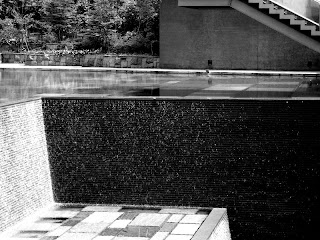 Waterfall made from ceramics tiles and pieces from the local artists.
 Looking south over the waterfall.
 The observation tower, high on the hill above the complex.
 View from the obsrvation tower.


 Posts
Posts


